
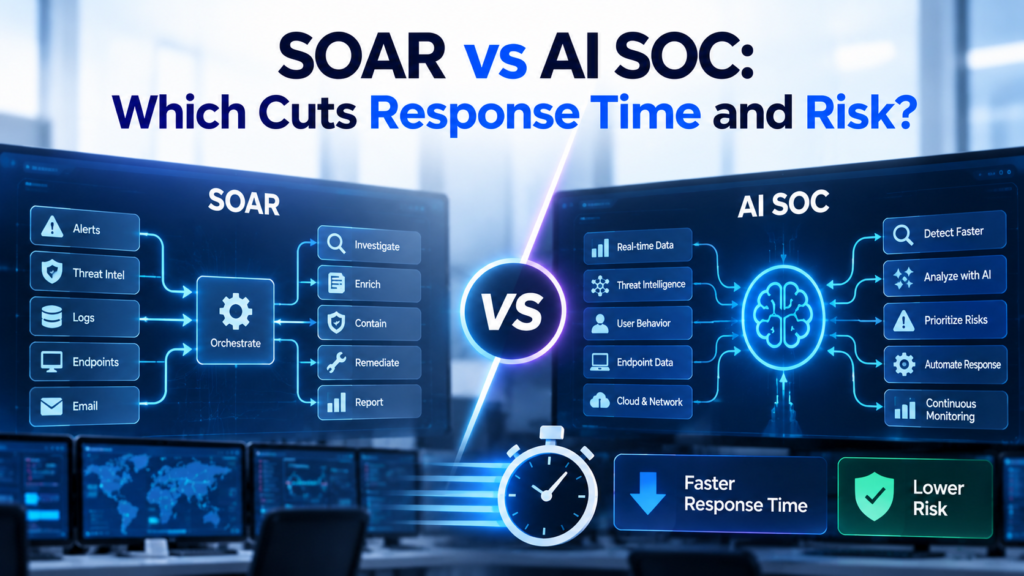
SOAR and AI SOC are not the same thing, not competing products, and not interchangeable. Here is what each actually does, where they overlap, and how to decide what your team needs
The market is confused. Vendors who sold SOAR for five years now call themselves AI SOC platforms. Vendors who built AI-first investigation tools call SOAR dead. Analysts evaluating platforms are told that SOAR is legacy and AI SOC is the future, or that AI SOC is hype and SOAR is the proven operational backbone. Both claims are partially right and mostly unhelpful.
The confusion exists because SOAR and AI SOC solve different layers of the same problem, and the best implementations use both. Understanding the distinction — and the overlap — is the difference between a productive evaluation and a wasted quarter.
What SOAR Actually Does
SOAR — Security Orchestration, Automation, and Response — is an integration and workflow engine. Its job is to connect security tools, define response procedures as automated playbooks, and execute those procedures consistently. The core value proposition is operational:
- Orchestration. A single platform that talks to your SIEM, EDR, TIP, firewall, email gateway, identity provider, ticketing system, and CMDB. Instead of an analyst copying an IP address from Splunk, pasting it into VirusTotal, copying the result into ServiceNow, and pasting the same IP into a firewall block rule — the playbook does all of that in sequence, in seconds, without errors.
- Automation. Predefined logic that executes without human intervention for known scenarios. If the alert matches these conditions, run these enrichment steps, apply this verdict, take this action. The automation is deterministic — given the same inputs, it produces the same outputs every time.
- Response. The ability to take action: block, isolate, quarantine, disable, notify. SOAR is not just an investigation tool — it is the execution layer that turns a decision into an action across your security stack.
SOAR’s strength is reliability and auditability. A well-built playbook does exactly what it says it will do, every time, and leaves a complete audit trail. Its weakness is rigidity: it can only handle
scenarios someone anticipated and coded for. A new alert type with no matching playbook falls through to manual processing.
What an AI SOC Actually Does
An AI SOC adds a cognitive layer on top of the operational infrastructure. Instead of following predefined logic, AI agents reason about alerts — interpreting evidence, forming hypotheses, making triage decisions, and adapting their approach based on what they find during an investigation:
- Intelligent triage. Instead of rule-based severity assignment, AI evaluates the alert in context: what asset is involved, what is the user’s behavioral baseline, does this pattern match known attack chains, what is the composite risk score from multiple evidence sources? The triage decision is probabilistic and contextual rather than deterministic and rule-based.
- Autonomous investigation. The AI does not follow a fixed enrichment sequence. It starts with the alert, decides which evidence to collect based on the alert type and initial findings, adjusts its investigation path as new evidence emerges, and produces a structured investigation report with a confidence-scored verdict.
- Adaptive learning. When analysts override AI verdicts, the feedback is incorporated. Alert types that the AI initially misclassified get corrected over time. The system learns the organization’s specific patterns, baselines, and risk tolerance — not just generic threat intelligence.
| SOAR answers: ‘What should we do when this happens?’ AI SOC answers: ‘What is this, how bad is it, and what should we do about it?’ One is a workflow engine. The other is a reasoning engine. The best platform is both. |
Where They Overlap — and Where They Do Not
The overlap is in response execution. Both SOAR and AI SOC platforms can block an IP, isolate a host, or quarantine an email. The mechanism is the same: an API call to the firewall, the EDR, or the email gateway. The difference is in how the decision to take that action is made.
In a pure SOAR model, the decision is encoded in the playbook. If conditions A, B, and C are met, take action X. The logic is static, transparent, and auditable — but brittle. In an AI SOC model, the decision is the output of a reasoning process that weighs evidence, assesses confidence, and may take different actions for alerts that look superficially similar but have different risk profiles based on asset criticality, user behavior, or attack chain context.
Where they do not overlap is in the scope of what they can handle. SOAR handles the known — scenarios you have seen before and codified into playbooks. AI SOC extends coverage to the unknown — alert types you have not seen before, novel combinations of indicators, and the long tail of alerts that no playbook exists for.
What Should You Actually Buy?
The answer depends on where your SOC is today:
- If you have no automation today, start with SOAR. Get the integrations stable, the case management schema defined, and the top 5 alert types automated. You need the operational plumbing before the cognitive layer adds value.
- If you have SOAR but are drowning in alerts, add AI triage. The playbooks are running, but the volume of alerts that do not match any playbook is growing. AI triage handles the unstructured middle — the alerts that are not obviously false positives and not obviously critical, the ones that consume 60% of analyst time.
- If you are evaluating from scratch, choose a platform that does both. A SOAR engine for deterministic, auditable workflows on known scenarios. AI agents for investigation, triage, and adaptive response on everything else. Separate tooling for these two layers creates an integration tax and a coverage gap.
The platforms that will win the next three years are the ones that treat SOAR and AI not as competing architectures but as complementary layers — orchestration for reliability, intelligence for coverage, and a clean boundary between them so you always know which layer made the decision and why.
Frequently Asked Questions
1. What is the difference between SOAR and an AI SOC?
SOAR primarily automates predefined security workflows and response actions, while an AI SOC uses AI to analyze incident context, support investigations, prioritize risks, and automate response decisions.
2. Is AI SOC faster than SOAR?
An AI SOC can reduce investigation and response time by analyzing multiple sources of security context and helping determine the next action, while traditional SOAR generally follows predefined playbooks.
3. Which is better for reducing security risk, SOAR or AI SOC?
Both can reduce security risk. SOAR provides consistent automated response, while an AI SOC can add contextual analysis and adaptive decision-making to help address more complex incidents.
4. Can an AI SOC replace SOAR?
Not necessarily. Many AI SOC platforms build on core SOAR capabilities such as playbooks, integrations, case management, and automated response rather than completely replacing them.
5. When should a security team choose SOAR?
SOAR is useful when a security team needs reliable automation of repetitive and well-defined response workflows using predefined playbooks.
6. When should a security team consider an AI SOC?
An AI SOC can be valuable when teams need deeper incident investigation, contextual analysis, faster decision-making, and automation that can adapt to different security scenarios.
7. Can SOAR and AI SOC work together?
Yes. SOAR can provide the automation and orchestration foundation, while AI can add investigation, reasoning, prioritization, and contextual decision-making on top of those capabilities.
8. Does AI SOC reduce analyst workload?
Yes. An AI SOC can reduce manual effort by handling repetitive investigation tasks, analyzing security context, and recommending or executing appropriate response actions within defined controls.