
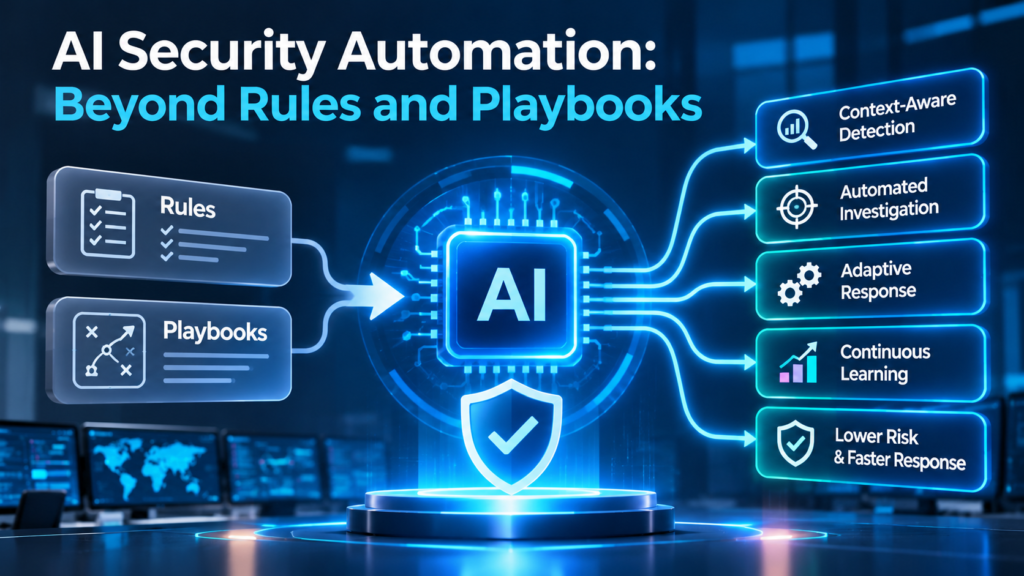
Playbooks got SOC teams through the last decade. But rules-based automation has a ceiling — and most teams hit it two years ago. What comes after is not more playbooks. It is a different kind of automation entirely.
Every SOC that adopted SOAR followed a similar trajectory. The first six months were transformative — top alert types got automated, MTTR dropped by half. Then the returns flattened. Playbook fifteen took as long to build as the first five combined. Playbook thirty required so many conditional branches that maintaining it consumed the time it saved. And around playbook fifty, the team realized the alerts causing the most pain were the ones no playbook could handle — too varied, too context-dependent, or too rare to justify the engineering effort.
This is not a failure of SOAR. It is the natural ceiling of rules-based automation. Rules work for the predictable. They break for everything else. In security, ‘everything else’ is where the risk lives.
The Playbook Ceiling
Rules-based automation operates on a simple principle: if this condition is true, do this action. The logic is explicit, deterministic, and auditable. These are genuine strengths. But they come with structural limitations that no amount of playbook engineering can overcome:
- Combinatorial explosion. A phishing playbook covering five gateway verdicts, three attachment types, four user risk levels, and two network zones needs 120 branches. Most teams build the top ten paths and hope the rest do not matter. The attacker is looking for the path you did not cover.
- Context blindness. A playbook that blocks an IP on a threat feed does exactly that — regardless of whether the IP is the organization’s own CDN that appeared on a feed due to a false submission. Rules see indicators. They do not see context.
- Maintenance debt. Every playbook is software that needs maintenance. When the EDR vendor changes its API, every playbook that calls it breaks. A library of 80 playbooks is 80 pieces of software with dependencies, version issues, and silent failures.
- Coverage gaps. The hardest alerts to automate are the ones that need it most — multi-stage attacks, lateral movement, insider threats. Too varied for static rules, they fall through to manual investigation and get the most fatigued, time-pressured response.
| The playbook ceiling is not a quality problem. It is an architectural one. You cannot solve it by writing better playbooks. You solve it by adding a layer that does not need playbooks to make decisions. |
AI-driven automation does not replace playbooks. It handles the space between them — the 40-60% of alert volume that is too varied for static rules but too routine to justify a senior analyst’s full attention. The mechanism is fundamentally different from rules-based automation:
- Evidence-based reasoning instead of conditional logic. An AI agent collects evidence from multiple sources, weighs it against context — asset criticality, user behavior baseline, historical patterns — and arrives at a verdict. The same alert type can produce different verdicts depending on context, exactly how a skilled analyst would handle it.
- Dynamic investigation paths. A playbook runs the same enrichment steps every time. An AI investigator evaluates initial results and decides which additional evidence to collect. If the source IP belongs to a known partner, it pivots to checking whether the user account was expected to connect from there — a path a static playbook would never take.
- Natural language understanding. AI agents read and interpret unstructured data that rules cannot parse — email bodies, ticket descriptions, Slack messages, PDF attachments. A phishing investigation requiring a human to judge email intent can be handled by an AI agent that understands language, not just indicators.
- Continuous calibration. When an analyst overrides a verdict, the system incorporates the feedback. When a new alert type appears, the AI investigates using general reasoning rather than waiting for a playbook. Coverage expands as the system encounters new scenarios.
The Hybrid Model: Rules Where They Work, AI Where They Do Not
The mature architecture is not AI-only. It is a hybrid where rules-based playbooks and AI agents each handle what they do best. The division is clean:
- Playbooks for deterministic, high-confidence actions. Blocking a known-malicious hash. Quarantining sandbox-confirmed malware. Disabling credential-stuffed accounts. Logic is clear, false-positive rate near zero, speed matters more than nuance.
- AI agents for ambiguous, context-dependent decisions. Is this login anomalous or just unusual? Is this data transfer exfiltration or a legitimate backup? These require weighing evidence, understanding context, and tolerating uncertainty — exactly what AI reasoning provides.
- Human analysts for high-stakes or politically sensitive decisions. Should we notify law enforcement? Take a production system offline during a revenue-critical period? These carry consequences beyond the technical domain and require judgment neither rules nor AI should make alone.
The boundary between these three layers should be explicit and adjustable. Every organization has a different risk tolerance, and the autonomy line needs to reflect it. A financial institution may require human approval for any containment action. A cloud-native startup may authorize AI to isolate a compromised container automatically. Both are valid. What is not valid is a platform that does not let you see or move the line.
Measuring What Matters
The metrics for AI automation are different from SOAR metrics. Playbook coverage — the percentage of alert types with a matching playbook — stops being the primary measure. What matters instead is decision quality across the full spectrum of alerts:
- Verdict accuracy. What percentage of AI verdicts are confirmed correct when reviewed? Measure through random sampling and retrospective review, not just override counts.
- Coverage depth. What percentage of alert volume receives a full investigation — not just enrichment, but reasoning about what the evidence means? Rules-only: 40-60%. With AI: approaching 100%.
- Time to decision. Not time to response — time to a confident, evidence-backed verdict. The goal is not sub-second response on easy alerts. It is sub-minute investigation on hard ones.
- Analyst leverage. How many alerts can one analyst supervise when AI investigates? If AI lets one analyst oversee 500 alerts per shift instead of investigating 40, the SOC economics change fundamentally.
Rules and playbooks were the right answer for the SOC of 2018. The SOC of 2026 faces a different problem — not a lack of automation, but a lack of intelligence in it. The platforms that close that gap will do it by adding reasoning to the automation stack and giving teams clear control over where the machine decides and where the human does.
Frequently Asked Question
1. What is AI security automation?
AI security automation uses artificial intelligence to analyze security events, investigate threats, and recommend or execute response actions with less reliance on manual processes.
2. How is AI security automation different from traditional security automation?
Traditional security automation relies mainly on predefined rules and playbooks, while AI security automation can analyze context and adapt its investigation and response based on the available evidence.
3. Can AI security automation work without predefined playbooks?
Yes. AI can dynamically determine investigation and response steps, although traditional playbooks remain useful for structured and repeatable security workflows.
4. What are the benefits of AI security automation?
It can reduce manual effort, accelerate security investigations, improve response consistency, reduce alert noise, and help security teams respond to threats faster.
5. Can AI replace security rules and playbooks?
No. Rules and playbooks remain important for predictable and repeatable processes. AI adds a more adaptive layer for situations that require contextual analysis and decision-making.
6. Is human oversight still needed with AI security automation?
Yes. Security teams should define appropriate levels of autonomy and retain human approval for complex, high-risk, or potentially irreversible actions.
