
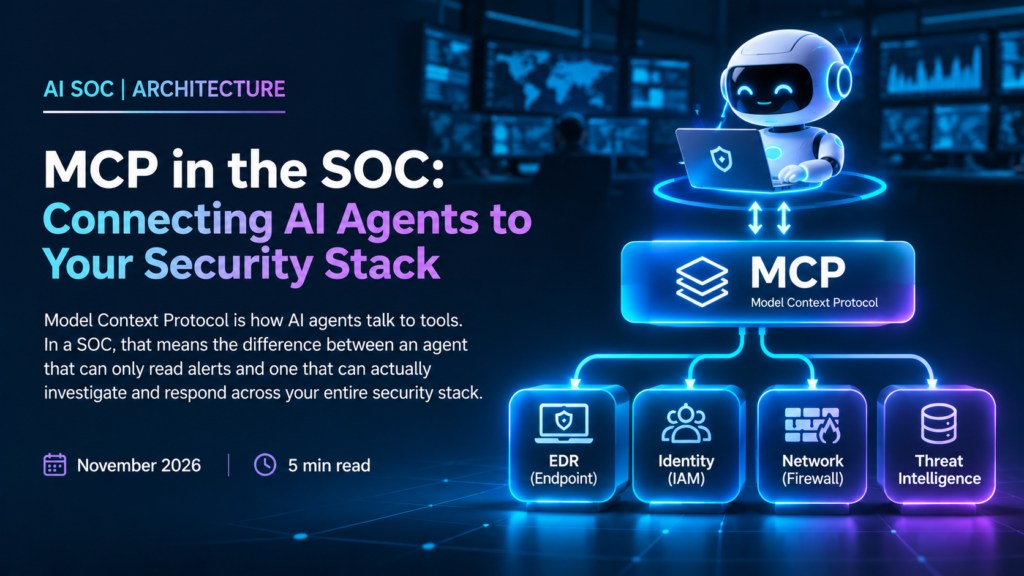
Model Context Protocol is how AI agents talk to tools. In a SOC, that means the difference between an agent that can only read alerts and one that can actually investigate and respond across your entire security stack.
Every AI SOC agent faces the same fundamental problem: it needs to interact with dozens of security tools, each with its own API, authentication model, data schema, and rate limits. The traditional approach — hardcoded integrations maintained by the platform vendor — works until it does not. A new EDR version ships, an API endpoint changes, or your team adopts a tool the vendor has not integrated yet, and the agent goes blind in that part of the stack.
Model Context Protocol (MCP) changes this equation. Instead of building point-to-point integrations between every agent and every tool, MCP defines a standard interface that any tool can implement and any agent can consume. The result is an integration architecture that scales with your stack rather than against it.
What MCP Actually Does
MCP is a protocol — a standardized way for AI agents to discover, authenticate with, and call external tools. In a SOC context, this means:
- Tool discovery. An agent can query what tools are available, what each tool does, what parameters it accepts, and what data it returns. Instead of hardcoding ‘call the CrowdStrike endpoint isolation API at this URL with these headers,’ the agent discovers that an endpoint isolation capability exists, understands its parameters, and calls it through a standard interface.
- Schema standardization. Every tool describes its inputs and outputs in a consistent format. An IP enrichment tool from VirusTotal and an IP enrichment tool from AbuseIPDB both describe their inputs as ‘IP address’ and their outputs as ‘reputation score, categories, last seen.’ The agent does not need tool-specific parsing logic for each vendor.
- Authentication abstraction. Each MCP server handles its own authentication — API keys, OAuth tokens, certificate-based auth. The agent calls tools through the protocol without managing credentials for every individual service. Credential rotation, token refresh, and auth failures are handled at the server layer.
- Capability boundaries. Each MCP server declares what it can and cannot do. A read-only threat intelligence server cannot be tricked into executing containment actions. The boundaries are structural, not just prompt-based, which matters for action safety.
Why This Matters for Security Operations
The practical impact in a SOC shows up in three places:
- Integration velocity. Adding a new tool to your AI SOC stops being a vendor dependency. If the tool vendor ships an MCP server — or your team wraps the API in one — the agent can use it immediately. No waiting for the platform vendor to build and certify an integration. A new threat intel feed, a cloud security posture tool, or a custom internal API becomes available to AI agents the day it ships an MCP interface.
- Multi-vendor flexibility. Lock-in decreases when integrations are standardized. Switching your EDR from CrowdStrike to SentinelOne does not require rebuilding every playbook and agent that called endpoint APIs — you swap the MCP server, and the agent’s tool calls route to the new backend. The investigation logic stays the same.
- Custom tool support. Every SOC has internal tools — a homegrown asset inventory, a custom risk scoring engine, a proprietary case management system. With MCP, wrapping these in a server makes them first-class citizens in the AI investigation pipeline, with the same discoverability and safety guarantees as commercial tools.
Architecture in Practice
A production MCP-based SOC architecture has three layers:
- MCP servers per tool domain. One server for endpoint security (EDR queries, isolation, forensic collection). One for identity (directory lookups, session enumeration, account actions). One for network (firewall rules, DNS lookups, flow data). One for threat intelligence (IOC enrichment, feed correlation). Each server encapsulates the tool-specific complexity and exposes clean capabilities.
- Agent orchestration layer. The AI agents sit above the MCP servers, choosing which tools to call based on the investigation context. A phishing alert triggers email analysis tools, then URL reputation, then identity lookup, then endpoint check — the agent decides the sequence based on what each step reveals, not a hardcoded playbook.
- Governance and audit layer. Every MCP call is logged — what tool was called, with what parameters, by which agent, in response to which alert. Permission policies control which
agents can call which tools: a triage agent can enrich but not contain; a response agent can isolate endpoints but not modify firewall rules. These boundaries are enforced at the protocol level.
The teams getting the most from MCP are the ones that treat it as infrastructure, not a feature. They build their MCP server library once, maintain it alongside their tool stack, and let every AI agent — current and future — benefit from the investment. The alternative is rebuilding the same integration for every new agent, every new use case, and every API change. That path does not scale.
Frequently Asked Questions
1. What is MCP in the SOC?
MCP, or Model Context Protocol, provides a standardized way for AI agents to discover and interact with security tools and systems across a SOC.
2. How does MCP connect AI agents to security tools?
MCP allows security tools to expose standardized capabilities through MCP servers, which AI agents can discover and call without requiring a separate hardcoded integration for every tool.
3. What are the benefits of MCP for security operations?
MCP can improve integration speed, reduce vendor lock-in, and make custom internal security tools easier to connect to AI-driven investigations.
4. How does MCP improve security when AI agents use tools?
MCP provides defined capability boundaries, allowing tools to specify what an AI agent can and cannot do. This helps separate read-only investigation actions from higher-risk response actions.
5. What does an MCP-based SOC architecture look like?
A production MCP-based SOC can use MCP servers for different security domains, an AI agent orchestration layer, and a governance and audit layer to control and monitor tool usage.
6. Does MCP replace existing security tools or playbooks?
No. MCP provides a standardized interface that allows AI agents to work with existing security tools and systems without requiring custom point-to-point integrations for every agent and tool. The official MCP documentation similarly describes MCP as an open standard connecting AI applications to systems where data and tools live