
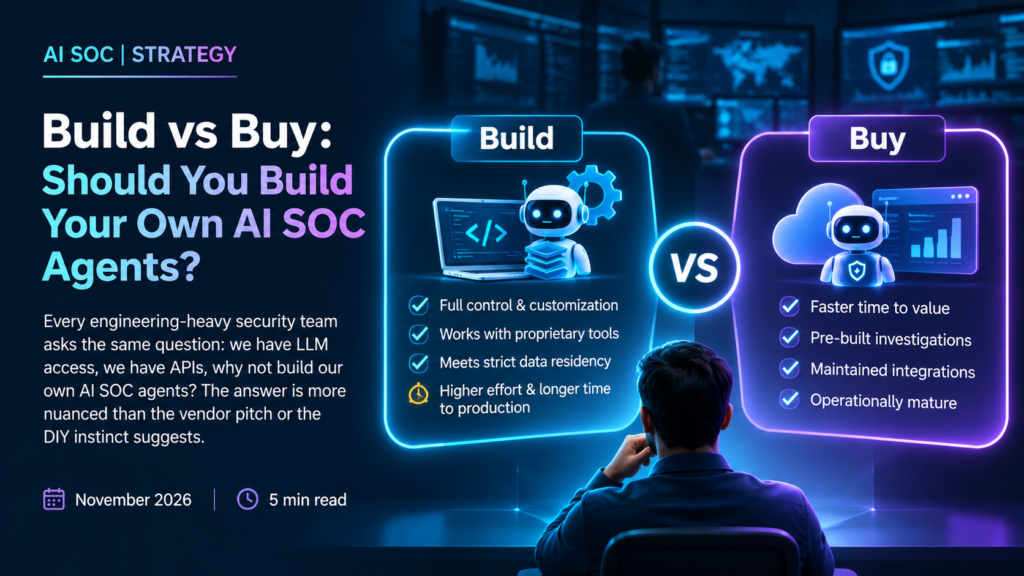
Every engineering-heavy security team asks the same question: we have LLM access, we have APIs, why not build our own AI SOC agents? The answer is more nuanced than the vendor pitch or the DIY instinct suggests.
The temptation is real. Large language models are accessible through APIs. Your SIEM, EDR, and ticketing systems all have REST endpoints. A competent engineer can wire up a prototype that reads an alert, queries VirusTotal, and drafts an investigation summary in a weekend. That prototype will demo beautifully. It will also take 12-18 months of engineering to turn into something you can trust with production security decisions — and by month six, the team maintaining it will wish they had not started.
This is not an argument against building. It is an argument for understanding what you are actually building before you commit engineering headcount to it.
What Looks Easy and Is Not
The gap between a working demo and a production AI SOC agent is not in the LLM call. It is in everything around it:
- Prompt engineering at scale. A prompt that works for phishing alerts fails on impossible-travel detections. One that handles Windows endpoint alerts misunderstands
Linux auditd logs. Production coverage means hundreds of prompt variations, each tested against real alert data, each maintained as detection logic and tool APIs evolve. This is not a one-time effort — it is an ongoing engineering commitment.
- Hallucination control. An LLM that fabricates an IP reputation score or invents a CMDB entry it did not query is worse than no automation at all — it creates false confidence. Production agents need structured tool calling with output validation, not free-form text generation. Every enrichment result must be verified against the actual API response, not the model’s summary of it.
- Action safety. An agent that can block an IP or isolate a host needs guardrails that prevent it from blocking your DNS servers or isolating a domain controller during Active Directory replication. These guardrails are not generic — they encode your infrastructure topology, your change windows, and your business-critical asset list. Building them means building an operational knowledge base, not just a prompt.
- Audit and compliance. Every automated decision needs a complete evidence chain: what data the agent saw, what reasoning it applied, what action it took, and why. Regulated industries need this chain to be tamper-evident and exportable. Building audit infrastructure is a project in itself.
When Building Makes Sense
There are legitimate reasons to build your own agents, and they cluster around a specific profile:
- Highly specialized environments. If your security stack includes proprietary systems with no standard APIs — custom-built detection engines, homegrown case management, or industry-specific compliance tools — a commercial platform may not integrate without significant customization. Building agents that speak your proprietary interfaces can be faster than waiting for vendor support.
- Data sovereignty requirements. If your regulatory environment prohibits alert data from leaving your infrastructure, and no commercial vendor offers a fully on-premises deployment that meets your requirements, building internally may be the only option.
- Deep institutional knowledge. Some organizations have investigation methodologies so specific to their environment that encoding them requires deep internal context. A commercial platform gives you the framework; the investigation logic still needs your team’s input regardless of build or buy.
Even in these cases, building the full stack — orchestration, agent framework, action safety, audit trail, feedback loops, model management — is rarely the right use of engineering time. Building the specialized layer on top of a commercial framework captures the advantage without the infrastructure burden.
When Buying Makes Sense
For most security teams, buying is the faster path to operational value:
- Immediate coverage. A commercial AI SOC platform ships with pre-built investigation patterns for common alert types — phishing, malware, impossible travel, brute force, data exfiltration. Building equivalent coverage from scratch takes months of prompt engineering and testing against real-world alert data.
- Maintained integrations. When CrowdStrike changes its API, or Microsoft updates the Defender schema, or Splunk modifies its search syntax, the vendor updates the integration. Your team does not maintain 200+ connector plugins.
- Operational maturity. Production AI agents need rate limiting, retry logic, circuit breakers, model failover, token budget management, and graceful degradation. These are solved problems in mature platforms and unsolved problems in every internal prototype.
- Feedback infrastructure. The mechanism for analysts to override verdicts, for those overrides to improve future decisions, and for the improvement to be measured — this closed-loop system is where AI SOC platforms compound value over time. Building it is a machine learning engineering project on top of the security engineering project.
The Decision Framework
Strip away the vendor marketing and the DIY enthusiasm, and the decision comes down to three questions:
- Where is your differentiation? If your competitive advantage is in your security operations methodology, build the parts that encode that methodology. If your advantage is in your product, your customer data, or your market position — not in how you investigate phishing alerts — buy the operational infrastructure and focus engineering on what matters.
- What is your maintenance budget? Building is a one-time cost. Maintaining is permanent. Every integration, every prompt, every guardrail needs ongoing engineering as your environment and the threat landscape evolve. Budget for the team that maintains it, not just the team that builds it.
- What is your time to value? A commercial platform delivers operational value in weeks. An internal build delivers it in months to years. If alert fatigue is burning out your analysts today, the timeline matters.
The best outcomes we see are hybrid: a commercial AI SOC platform for the operational backbone — integrations, orchestration, audit, feedback loops — with custom agents built on top for the investigation logic that is genuinely unique to the organization. You get production reliability without giving up the specificity that makes your security program effective
Frequently Asked Questions
1. Should organizations build or buy their own AI SOC agents?
For most organizations, buying a commercial AI SOC platform is the faster way to achieve operational value. Building internally makes sense when an organization has highly specialized security requirements, proprietary systems, or strict data sovereignty needs.
2. How much time does it take to build an AI SOC agent?
A basic AI SOC agent prototype can be built in a few days, but developing a production-ready system can take 12–18 months of engineering effort, including testing, integrations, safety controls, and ongoing maintenance.
3. What are the challenges of building an AI SOC platform in-house?
The main challenges include prompt engineering, hallucination control, integration maintenance, action safety, audit trails, compliance, and ongoing model management.
4. When does building a custom AI SOC agent make sense?
Building custom agents makes sense when an organization uses proprietary security systems, has strict data sovereignty requirements, or needs investigation logic based on specialized internal knowledge that commercial platforms cannot easily support.
5. What are the benefits of buying a commercial AI SOC platform?
A commercial AI SOC platform can provide pre-built investigation workflows, maintained integrations, operational maturity, feedback mechanisms, and faster deployment without requiring an organization to build and maintain the entire infrastructure.
6. Can organizations combine a commercial AI SOC platform with custom AI agents?
Yes. A hybrid approach allows organizations to use a commercial platform for integrations, orchestration, audit trails, and feedback loops while building custom agents for specialized investigation requirements.