
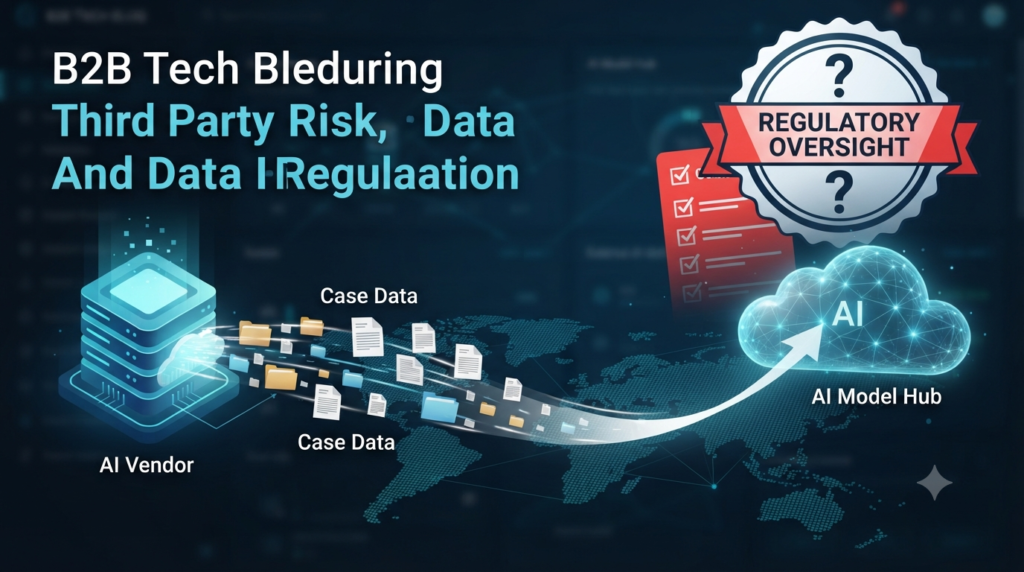
Most AI-powered security tools route your alert data through third-party LLMs. In regulated markets, that is a compliance problem hiding in your architecture.
Your SOAR vendor added an AI assistant last year. It summarizes cases, recommends response actions, and generates investigation narratives. Your analysts love it. Your compliance team has not asked where the AI runs. They should.
Most AI features in security products are powered by third-party large language models, typically OpenAI’s GPT or Anthropic’s Claude, accessed via API. When your analyst asks the AI to summarize a case, the alert data, IOCs, internal hostnames, user identities, and investigation notes are sent to that third-party API endpoint for processing. The vendor’s privacy policy may say the data is not retained for training. But it still leaves your network, crosses jurisdictional boundaries, and is processed on infrastructure you do not control.
| The question is not whether the LLM provider retains your data. The question is whether your regulator considers sending security telemetry to a third-party AI service as a data transfer, and whether that transfer was authorized. |
Why This Matters in Regulated Markets
In the UAE, NESA’s data classification framework restricts the transfer of sensitive government and critical infrastructure data outside national boundaries. Security telemetry from a government SOC routed through a US-hosted LLM API may violate those restrictions. In Singapore, MAS Technology Risk Management guidelines require financial institutions to assess and manage risks arising from cloud and third-party AI services. In India, CERT-In’s reporting obligations and the Digital Personal Data Protection Act create obligations around where incident data is processed and stored.
None of these regulations explicitly ban AI in security operations. But all of them create obligations that most AI-powered security tools do not satisfy by default, because the default architecture routes data to external LLMs.
What Your Vendor Is Probably Not Telling You
- Which model provider processes your data. Some vendors disclose this. Many do not, or bury it in a sub-processor list that your procurement team did not review.
- What data is sent in the API call. Is it the raw alert? A sanitized summary? The full investigation context including internal IPs, hostnames, and user identities? The answer determines your regulatory exposure.
- Where the processing happens. Even if the vendor is headquartered in your jurisdiction, the LLM API endpoint may be in a US or EU data center. The data crosses borders regardless of where the vendor sits.
- Whether you can opt out. Some vendors let you bring your own model or disable AI features. Others have AI baked into the core pipeline with no opt-out. Know which one you bought.
What the Alternative Looks Like
The architecture that satisfies data sovereignty requirements is not complicated in concept: run the AI model on infrastructure you control, inside your jurisdictional boundary. In practice, this means deploying a locally hosted LLM — typically an open-weight model like Llama fine-tuned on security data — on your own hardware or in a sovereign cloud environment.
This approach has trade-offs. Locally hosted models are smaller and less capable than frontier models. A fine-tuned 8B parameter model will not match GPT-4 on open-ended reasoning tasks. But for structured security operations — alert triage, IOC enrichment, playbook selection, case summarization — a well-tuned local model can handle 85-90% of the workload without any data leaving your perimeter. The remaining cases that need frontier-level reasoning can be routed to an external model with explicit data sanitization, or flagged for human handling.
The honest framing is a two-tier architecture: sovereign AI for the majority of cases, frontier AI for the edge cases that justify the data transfer, with the analyst and the compliance team making that call — not the platform.
Three Questions for Your Next Vendor Review
- Where does the AI processing happen? Get the specific infrastructure: cloud region, provider, and whether the data leaves your jurisdiction at any point in the pipeline.
- Can I run the AI entirely on-premises? Not “can I host the platform on-prem while the AI calls an external API.” Can the AI model itself run on my infrastructure, with zero external dependencies?
- What data is included in the AI API call? Ask for a sample payload. If it includes raw alert data, internal identifiers, or investigation context, your compliance team needs to assess
whether that transfer is authorized under your regulatory framework.
Your regulator is going to ask these questions eventually. Better to have the answers before they do.
Frequently Asked Questions
1. What are the compliance risks of sending case data to AI models?
Sending security case data to external AI models can create compliance risks around data privacy, data residency, regulatory requirements, and auditability, especially when sensitive investigation data leaves the organization’s environment.
2. Can AI vendors send customer data to external AI models?
It depends on how the AI solution is designed. Some vendors process data through external cloud AI services, while others offer on-premises or private AI deployments that keep data within the organization’s environment.
3. Why should security teams know where AI processes their data?
Security teams need visibility into how AI handles case data because regulators and internal auditors may require proof of where data is processed, stored, and protected during investigations.
4. How can organizations use AI while maintaining compliance?
Organizations can reduce compliance risks by choosing AI solutions with strong data governance, audit trails, access controls, private deployments, and clear data processing policies.
5. What should CISOs ask an AI vendor before deployment?
Before adopting an AI solution, CISOs should ask where data is processed, whether customer data is used for model training, what compliance certifications the vendor holds, how audit logs are maintained, and whether on-prem or private deployment options are available.