
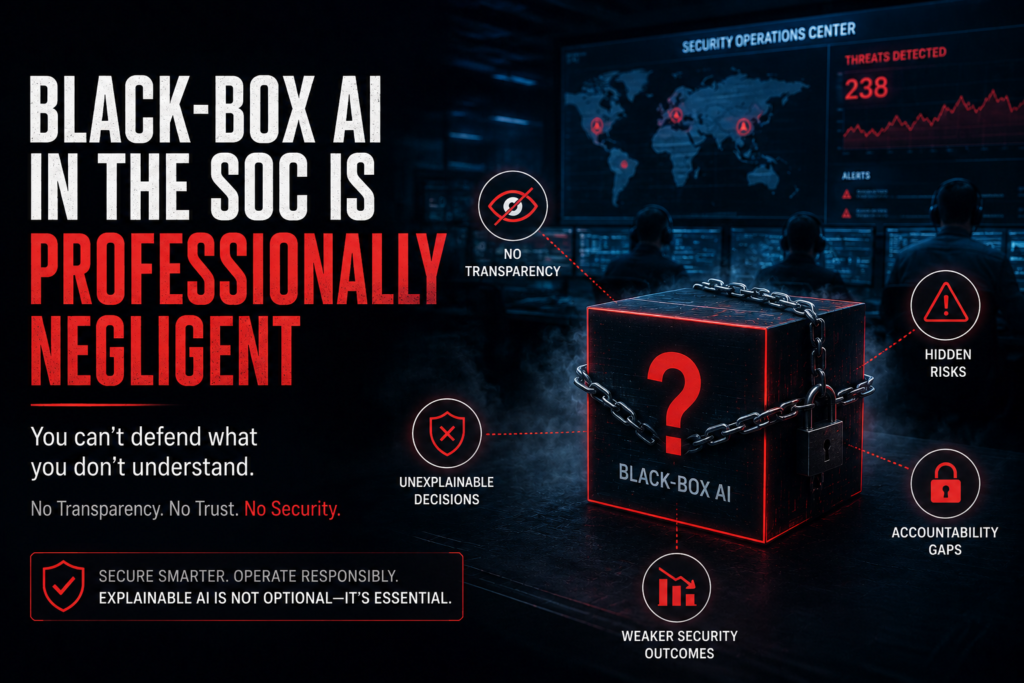
If your AI agent makes decisions your analysts cannot explain, you do not have automation. You have liability.
A SOC analyst closes a case. The AI agent told them it was a false positive. They click confirm and move on. They do not know why the agent reached that verdict. The agent does not tell them. The platform does not show a reasoning chain, a confidence score, or the evidence it evaluated. The analyst trusted it because it has been right before, and because there are 140 other alerts in the queue.
Three weeks later, a breach investigation traces the initial access back to that alert. The auditor asks a simple question: why was this classified as benign? Nobody can answer. Not the analyst, not the platform, not the vendor. The decision was made inside a model nobody can inspect, based on logic nobody can reproduce.
This is not a hypothetical. This is the operating reality of every SOC running AI agents without explainability. And it is professionally negligent.
Why Black-Box AI Is Different from Other Automation
SOC teams have used automation for years. SIEM correlation rules, SOAR playbooks, and enrichment scripts all make decisions without human intervention. The difference is that every one of those tools is inspectable. You can read the rule logic. You can trace the playbook steps. You can see which enrichment source returned what data. When something goes wrong, you can reconstruct the decision. Black-box AI breaks that chain. The model takes inputs and produces outputs. The reasoning in between is a statistical computation across millions of parameters that no human can interpret. When the model says false positive, you cannot ask it to show its work in a way that an analyst, an auditor, or a regulator can evaluate.
| The standard you should apply is simple: if your AI agent makes a security decision that you cannot explain to an auditor after the fact, you should not be letting it make that decision autonomously. |
What Is Actually at Stake
Regulatory exposure. The EU AI Act classifies AI used in critical infrastructure as high-risk, which mandates transparency, human oversight, and documented decision-making. Security operations in regulated industries will fall under this scope. An unexplainable AI verdict on a security alert is a compliance violation waiting to be discovered.
Incident response paralysis. When a breach occurs and the investigation reaches an AI-made decision, the team needs to understand what the agent knew, what it considered, and why it chose the action it took. Without that, the investigation stalls at the AI boundary. You cannot do root cause analysis on a decision you cannot decompose.
Analyst deskilling. When analysts rely on verdicts they cannot evaluate, they stop developing the judgment that makes them effective. After a year of clicking confirm on AI decisions they do not understand, your junior analysts have not learned triage. They have learned to click confirm. That is not the same thing.
What to Demand from Your AI
Explainability is not a feature request. It is a minimum operating requirement. Here is what the bar should look like:
- Structured reasoning chains. Every verdict should include: what data the agent evaluated, what patterns it matched, what similar cases it referenced, and what confidence level it assigned. Not a paragraph of generated text. A structured, auditable chain an analyst can follow step by step.
- Confidence scores with calibration. The agent should express how certain it is, and that certainty should be empirically calibrated. When it says 90% confident, it should be right 90% of the time. If it is not, your automation thresholds built on those scores are operating on false precision.
- Override instrumentation. Every analyst override of an AI verdict should be logged, categorized, and fed back into model evaluation. The override rate is your real-world accuracy metric. If you are not tracking it, you are flying blind.
- Autonomy boundaries. Not every decision should be autonomous. Define which verdicts the agent can act on alone, which require analyst confirmation, and which must be fully manual. These boundaries should be configurable per severity, per category, and per confidence level.
The Professional Standard
Security is a profession built on accountability. Every firewall rule has an owner. Every change has a ticket. Every incident has a post-mortem. We built these practices because we learned,
repeatedly, that unaccountable decisions in security operations lead to preventable failures.
AI agents do not get an exemption from that standard because the technology is new or because the math is complicated. If anything, the standard should be higher, because the decisions are faster, more numerous, and harder to catch when wrong.
If your vendor cannot show you how their AI reaches its verdicts, that is not a product limitation. It is a professional risk you are choosing to accept. Name it as such. Put it in the risk register. And decide whether that is a risk your organization is willing to carry when the auditor, the regulator, or the breach investigator comes asking why.