
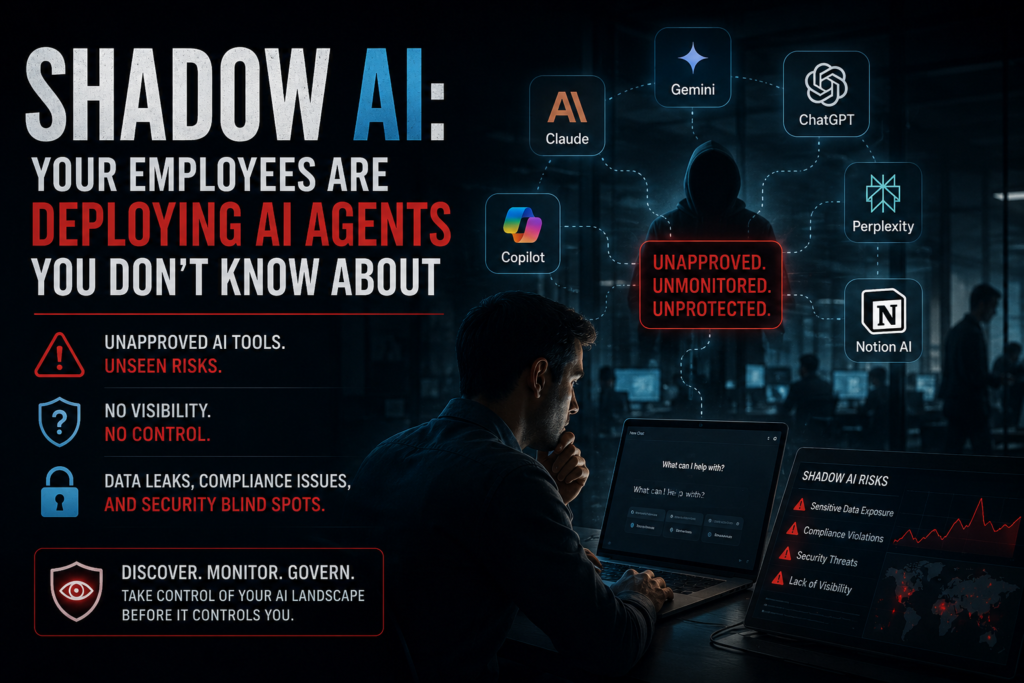
The next shadow IT crisis is already here. It runs on API keys, not VPNs.
Remember when employees started spinning up their own AWS instances because IT took six weeks to provision a server? That was shadow IT. We spent a decade building policies, approval workflows, and detection tooling around it. Then we mostly got it under control.
Shadow AI is the same instinct, but the consequences are worse.
Across industries right now, employees are plugging company data into ChatGPT, connecting AI agents to internal systems via personal API keys, and automating chunks of their job with tools their security team has never heard of. This is not speculative. If your organization has more than 200 people and no AI usage policy enforced at the network level, it is almost certainly happening today.
What Shadow AI Actually Looks Like
The term sounds dramatic, but the reality is mundane. A marketing analyst pastes customer feedback into Claude to write summaries. A developer hooks up a coding agent to the company’s GitHub repo using a personal access token. A finance team member uploads a P&L; spreadsheet to an AI tool to generate variance commentary.
None of these people think they are doing something risky. They are trying to get their work done faster. The AI tools are free or cheap, instantly accessible, and shockingly good at the tasks that eat up most of a knowledge worker’s day.
That is exactly what makes it dangerous.
| A 2025 survey by Cyberhaven found that 74% of ChatGPT usage at work occurred on personal accounts, completely outside corporate visibility. The data that leaves through those sessions doesn’t show up in your DLP logs. |
Why This Is Happening Now, Not Two Years Ago
ChatGPT launched in late 2022, and the initial reaction from security teams was reasonable: block it or write a policy. Many organizations did both. But AI agents in 2026 are a different animal. They are not just answering questions. They are taking actions.
Three things changed:
- Agents can now connect to enterprise systems. MCP (Model Context Protocol), function calling, and tool-use capabilities mean an AI agent can read your Jira board, query your Snowflake warehouse, and send Slack messages. An employee who connects one of these agents with their SSO credentials has effectively given an external AI read and sometimes write access to internal systems.
- The barrier to deployment is zero. You do not need infrastructure to run an AI agent. You need a browser, an API key, and 10 minutes. There is nothing for IT to detect in a traditional sense because no software gets installed on a managed device.
- The tools got genuinely useful. Early chatbots were fun but limited. Modern agents can draft incident response reports, triage support tickets, generate code patches, and summarize 200 page contracts. The productivity gain is real enough that employees will route around policy to keep using them.
The Risks Nobody Wants to Quantify
When security teams think about shadow AI, they tend to focus on data leakage. That is a real risk, but it is not the only one, and probably not the worst.
Data exposure
This is the obvious one. Customer PII, source code, financial projections, M&A; plans, legal strategy docs. Every piece of data pasted into a third-party AI service leaves your perimeter. Some providers train on your inputs. Some retain them for 30 days. Some do neither but their subprocessors might. Your employees do not read the terms of service. Neither do most of your security analysts, if we are being honest.
Unaudited actions
An AI agent connected to your ticketing system can close tickets. One connected to your cloud console can modify configurations. One connected to your email can send messages on behalf of employees. These actions happen outside your SIEM, outside your change management process, and outside your audit trail. If something goes wrong, you will not know what happened or why until you manually reconstruct it.
Compliance violations
For organizations subject to GDPR, HIPAA, PCI DSS, or any of the new AI-specific regulations rolling out across the EU, sending regulated data to an unsanctioned AI service is not just a policy violation. It is a legal one. The fines are not theoretical anymore.
Supply chain risk via prompts
Employees copy and paste prompts from blog posts, GitHub repos, and social media without thinking about it. Some of those prompts include instructions that extract data, call external URLs, or manipulate agent behavior. Prompt injection is a real attack vector, and your employees are the ones introducing it.
Why Blocking AI Does Not Work
Some organizations tried the simple approach: block ChatGPT, Anthropic, Gemini, and every other AI endpoint at the proxy. Here is what happened.
Employees switched to personal devices. They tethered to phone hotspots. They used AI features embedded in tools already approved by IT, like Notion AI, Canva, Grammarly, and GitHub Copilot, that nobody realized also send data to external models. A few technically savvy ones set up local models on personal hardware and transferred data via USB.
Prohibition did not reduce usage. It eliminated visibility.
This is the same pattern we saw with BYOD 15 years ago. You cannot win by banning tools that make people meaningfully more productive. You can only win by making the sanctioned path easier than the unsanctioned one.
What Actually Works
The organizations handling this well share a few things in common. None of them banned AI outright. All of them accepted that employees will use these tools and built guardrails around that reality.
Deploy a sanctioned AI layer with DLP
Give employees an approved AI interface that works as well as the consumer tools they are sneaking in. Route it through a gateway that inspects prompts for sensitive data before they leave the perimeter. This is not a nice to have. It is the minimum viable response.
Inventory AI touchpoints in your environment
Most organizations have no idea how many AI-powered features are active in their approved SaaS stack. Salesforce Einstein, Microsoft Copilot, Google Duet AI, Slack AI, Zoom AI Companion.
These are already running. Each one has its own data processing terms. Each one is a potential exfiltration path. You need a register of every AI feature in every tool you use, what data it accesses, and where that data goes.
Monitor for API key sprawl
Employees signing up for AI services use personal emails, but they often generate API keys that get committed to code, stored in config files, or shared in Slack channels. Scanning for API key patterns (sk-…, key-…, Bearer tokens for known AI providers) is straightforward and immediately actionable.
Build an AI usage policy that humans will follow
Most AI policies read like they were written by legal for legal. Nobody on the sales team reads a 14 page acceptable use policy. Write a one pager with specific examples. What can I paste into ChatGPT? What can I not? What happens if I am not sure? Make the answers concrete and the escalation path frictionless.
Govern AI agents like you govern service accounts
If an employee connects an AI agent to a company system, that agent should be treated like a service account. It needs scoped permissions, an audit trail, an owner, and a review cycle. The agent governance framework is the piece most organizations are missing entirely.
What This Means for Your SOC
Security operations teams are in an awkward position. They are supposed to detect unauthorized AI usage, but their own tooling is not built for it. SIEM rules do not fire on an employee pasting text into a browser. DLP policies miss data sent through API calls from personal machines. Network monitoring catches the domain but not the content.
The SOC needs three things to handle shadow AI:
- Visibility into AI-specific telemetry. DNS queries to known AI endpoints, OAuth grants to AI services, API key creation events in cloud consoles.
- Triage logic that understands context. Not every ChatGPT query is a data breach. You need to distinguish between an employee asking for a recipe and one uploading a customer database. This requires content-aware analysis, not just URL blocking.
- Agent audit trails. When AI agents take actions in your environment, those actions need to be logged with the same rigor as human actions. Every API call, every data access, every modification.
If your SOC cannot do these three things, you have a blind spot that grows every week as AI adoption accelerates.
The Uncomfortable Truth
| The employees using shadow AI are usually your best performers. They are the ones who care enough about productivity to find better tools on their own. Punishing them drives the behavior underground. Enabling them with guardrails turns a risk into an advantage. |
Shadow AI is not a technology problem. It is an organizational one. The technology exists to deploy AI safely within a governed perimeter, with DLP, with prompt inspection, with audit trails, and with data that never leaves your environment. The gap is that most security teams have not built or bought that infrastructure yet, and employees are not going to wait.
Every week you delay deploying a governed AI layer is another week your employees build habits and workflows on ungoverned tools. Migrating them back gets harder the longer you wait.
Where to Start
If you are a CISO or SOC leader reading this, here is a practical sequence:
- This week: Run a DNS analysis for known AI service domains across your network. You will be surprised by the volume.
- This month: Inventory every AI feature embedded in your sanctioned SaaS tools. Build a register.
- This quarter: Deploy a governed AI gateway with DLP and prompt inspection. Give employees something better than what they are using in secret.
- Ongoing: Build an agent governance framework. Treat AI agents as service accounts with scoped access, audit logs, and periodic review.
Shadow AI is not going away. The question is whether your organization gets ahead of it with governance, or discovers it the hard way through a breach notification.
Frequently Asked Questions
What is ‘Shadow AI’ and how is it different from traditional shadow IT?
Shadow AI refers to employees using AI tools and agents that IT and security teams haven’t sanctioned or reviewed, such as pasting company data into personal ChatGPT accounts or connecting AI agents to internal systems with personal API keys. Unlike older shadow IT, which mainly involved spinning up unauthorized infrastructure, Shadow AI requires no installation and is much harder to detect.
Why is Shadow AI happening more now than a couple of years ago?
The blog points to three shifts: AI agents can now connect directly to enterprise systems via protocols like MCP and take real actions, deployment requires nothing more than a browser and an API key, and the tools have become genuinely useful enough that employees will route around policy to keep using them.
What are the main risks Shadow AI introduces beyond simple data leakage?
Besides data exposure through pasted or uploaded content, the blog highlights unaudited actions taken by connected agents (like closing tickets or modifying cloud configurations), compliance violations under regulations like GDPR or HIPAA, and prompt injection risk introduced by employees copying prompts from external sources.
Why doesn’t simply blocking AI tools at the network level work?
When organizations blocked AI services outright, employees switched to personal devices, tethered to phone hotspots, or used AI features already embedded in approved tools like Notion, Canva, or GitHub Copilot. Blocking eliminated visibility rather than reducing usage, similar to what happened with early BYOD policies.
What does a governed, sanctioned approach to AI usage actually involve?
It includes deploying an approved AI interface routed through a gateway that inspects prompts for sensitive data, maintaining an inventory of every AI feature embedded across the approved SaaS stack, monitoring for stray API keys, and writing a short, practical usage policy people will actually read and follow.
Why should AI agents be governed the same way as service accounts?
Once an employee connects an AI agent to a company system, that agent should be treated with the same rigor as any other service account: scoped permissions, an audit trail, a designated owner, and a periodic access review, since ungoverned agent access is functionally similar to an unmanaged machine identity.
What three things does a SOC need to actually detect and handle Shadow AI?
According to the blog, SOCs need visibility into AI-specific telemetry such as DNS queries to AI endpoints and OAuth grants, context-aware triage logic that can distinguish benign use from actual data exposure, and audit trails for every action an AI agent takes, logged with the same rigor as human actions.