
SOAR is not dead. But the category is being absorbed into something larger. Here is how to evaluate what comes next.
Every analyst report in 2025-2026 has declared SOAR dead, dying, or evolving. Gartner folded it into SecOps platforms. Vendors rebranded overnight: yesterday’s SOAR is today’s AI SOC, Autonomous SOC, or Agentic Security Platform. The playbook builder got an LLM wrapper. The marketing site changed. The product underneath, in most cases, did not.
If you are evaluating platforms in 2026, you need to see past the rebrand. The capabilities that matter have not changed as much as the naming conventions suggest. What has changed is the expectation of what automation should do, and the introduction of AI agents as a new architectural layer on top of the orchestration engine.
What Actually Changed
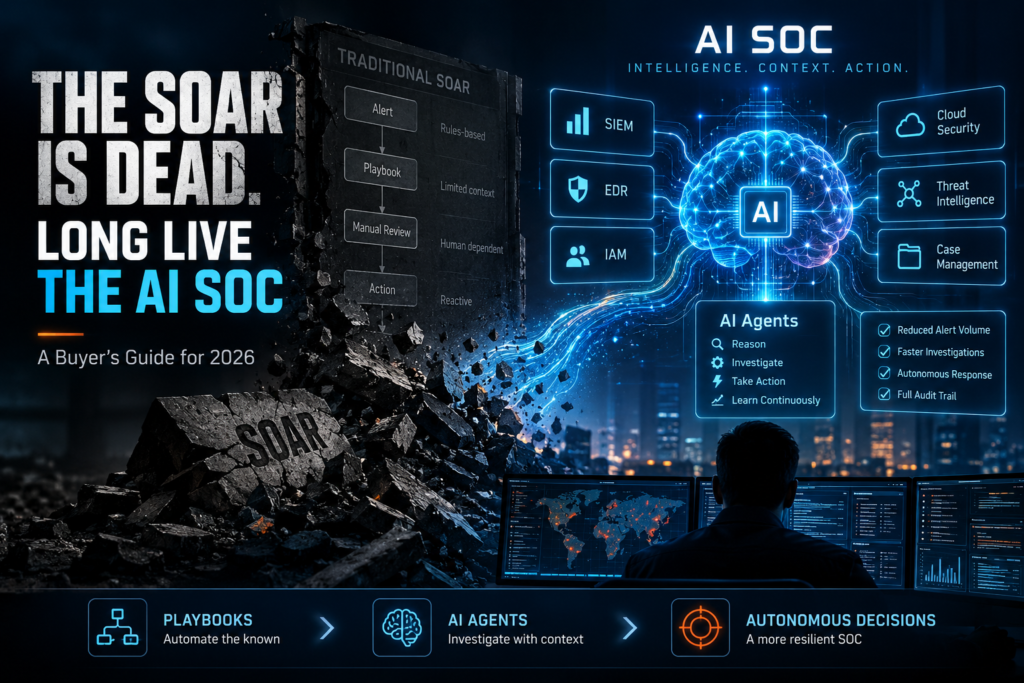
- From playbooks to agents. Traditional SOAR runs predefined playbooks: if-this-then-that logic authored by a human. Agentic platforms add AI agents that can decide their own investigation path based on the case context. The playbook is the floor, not the ceiling.
- From enrichment to reasoning. SOAR enriches alerts with data from threat feeds and asset databases. AI SOC platforms reason over that enrichment: is this combination of IOCs consistent with a known attack pattern? Does this alert correlate with the three that fired yesterday?
- From orchestration to autonomy. SOAR orchestrates actions a human pre-authorized. AI SOC platforms introduce a spectrum of autonomy where the agent can take certain actions without pre-authorization, within configurable boundaries.
| The core SOAR capabilities — case management, playbook orchestration, integration fabric, and response actions — are not going away. They are becoming the foundation layer that the AI agent sits on top of. A platform without strong SOAR fundamentals cannot deliver reliable agentic automation. |
What to Evaluate: A Practical Checklist
Ignore the category name. Evaluate these capabilities:
- Case management depth. Can you build custom case workflows, link related cases, track SLA by severity, and maintain a full audit trail? If the platform skipped the case management fundamentals to focus on AI, you will feel the gap in month two.
- Integration breadth and write access. Count the integrations. Then check how many support write actions (block, isolate, disable, revoke) versus read-only enrichment. Enrichment without response is a research tool, not a SOC platform.
- Playbook flexibility. Can you build custom playbooks without the vendor’s professional services team? Can you version, test, and roll back playbooks? The AI layer augments playbooks. It does not replace the need for them.
- AI transparency. When the AI agent makes a decision, can you see the reasoning chain? Can your analysts override it? Is the override tracked? If the AI is a black box, you have the same problem as a playbook nobody documented.
- Deployment model. Can you run the platform and the AI on-premises or in a sovereign cloud? If your deployment requires routing data to a US-hosted LLM, that is a deal-breaker for regulated markets.
- Noise reduction architecture. How does the platform reduce alert volume before cases reach analysts? Clustering, deduplication, and AI-based triage are table stakes. Ask for the noise reduction ratio from a reference customer.
The Honest Buying Decision
If your SOC is drowning in alerts and your analysts spend 80% of their time on repetitive triage, you need strong automation fundamentals before you need an AI agent. A well-built playbook engine that handles 70% of your volume deterministically is worth more than an AI agent that handles 90% of your volume but cannot explain how it got there.
The right platform gives you both: the orchestration foundation to automate the predictable, and the AI layer to assist with the rest — with transparency, configurable autonomy, and a deployment model that fits your regulatory reality. Buy the foundation first. The intelligence layer is only as good as the plumbing underneath it.
Frequently Asked Questions
1. Is SOAR dead in 2026?
No. SOAR is not dead, but it’s evolving into AI-powered Security Operations platforms. Traditional SOAR capabilities like playbooks, case management, and integrations remain essential, while AI agents add reasoning and autonomous investigation on top of those foundations.
2. What’s the difference between SOAR and an AI SOC?
Traditional SOAR automates predefined workflows using human-created playbooks. An AI SOC builds on those capabilities by adding AI agents that can analyze context, make investigation decisions, and assist with incident response within configurable boundaries.
3. What should buyers look for when evaluating an AI SOC platform?
Instead of focusing on marketing terms, buyers should evaluate case management, integration capabilities, playbook flexibility, AI transparency, deployment options, and how effectively the platform reduces alert noise before incidents reach analysts.
4. Why is AI transparency important in security operations?
Security teams need to understand how AI reaches its decisions. A platform should provide a clear reasoning chain, allow analysts to override AI decisions, and maintain a complete audit trail for governance and compliance.
5. Can an AI SOC replace traditional SOAR completely?
Not completely. The strongest AI SOC platforms build on proven SOAR capabilities rather than replacing them. Reliable automation still depends on strong playbooks, integrations, and case management, with AI enhancing those capabilities instead of replacing them.